restoration avocation
In this summer of crisis upon catastrophe upon crisis, I often find myself in need of distraction, so this morning I thought I'd pull back the curtain on one of my quirkier quirks. Perhaps all this recent drama and chaos is a sign that it's time to resume the craft, to divert my thoughts from the urgency of today and settle into the soothing calm of yesteryear. Though I haven’t done much of it lately, one of my more unconventional hobbies is digitally restoring antique photographs, eliminating the dust, foxing, discoloration, cracks and creases that occur with age, while boosting the light, contrast, and overall tint to replicate how I imagine the original would have appeared when it proudly made its inaugural debut upon the mantel. When possible, I’ve even recreated the missing portion of a photo that has been badly stained or torn away. On rarer occasions, I have also duplicated a restored image and partially or completely colorized an alternate version to mimic the hand-colored portraiture of a bygone era. I’ve undertaken every one of these steps with manual precision since long before publicly accessible AI programs ever existed.
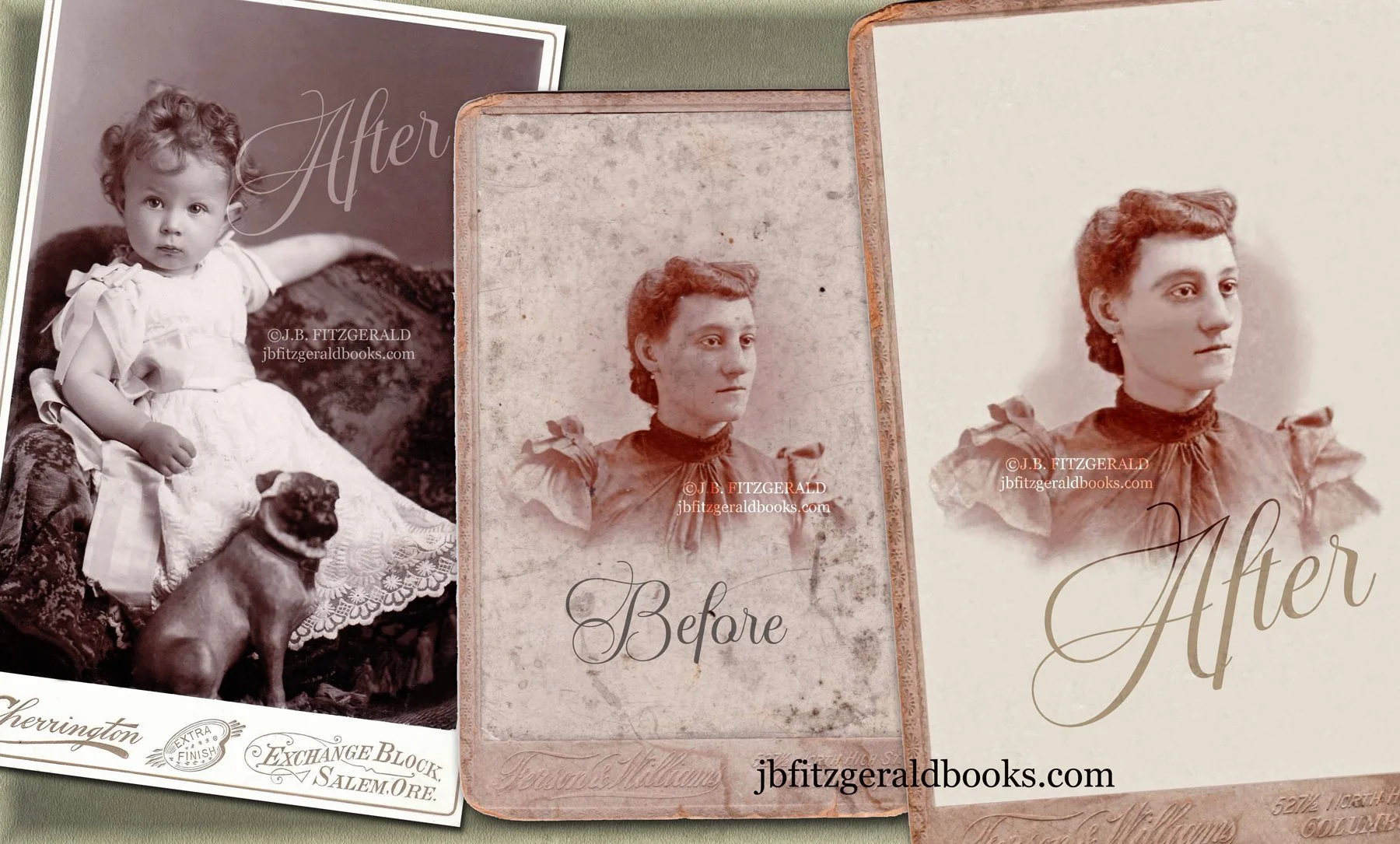
They’re not always family, the people in these images. In fact, most of the time, they are known to me only with such monikers as Girl with Apple or Young Woman with Plumes in Hat. In the photos shown here, Curly Haired Child with Dog is mostly a mystery to me, excepting one hypothesis stemming from my keen deductive skills—that the two grew up together somewhere in or near Salem, Oregon. The other photo, however, has personal significance. This is my great grandmother, Franciszka, as a young woman, circa 1900-1902. I never knew her—she died at 51, fifteen years before my mother was even born—but I often imagine what she must have been thinking as she sat there, stiff as a board, waiting for the photographer to complete this portrait. I suspect this was taken within a year of her wedding date. Had she any notion she’d go on to deliver fourteen of her fifteen children on the kitchen table of her home, or that three of them would die before ever reaching their first birthdays? Had she navigated the life expected of her or the life she had consciously chosen? Had she been happy? Fulfilled? Or merely exhausted? (Even if she'd found herself satisfied with her path, I think it’s fair to presume, with a dozen kids underfoot, exhausted had been a given.) Had she had any inkling that her middle child would grow up to shun expectations and conformity and become the best grandma ever? I’ll never know what my great-grandmother was like, what dreams she’d longed to pursue, what opportunities she'd wished had been available to women of her time. I have only had the honor of acquainting myself with Franciszka through this photograph, through the careful cleaning, painting, touching up of her youthful features. As you can see from the “before” image, significant work was required for this restoration—for most of them, in fact—but I’d do it again in a heartbeat if another portrait of her ever came my way.
When I stumble upon an old ragged photo, the need to restore it is practically reflex. I admire the aesthetic of these long lost treasures, and that is motivation enough. Yes, the subjects often look desperately dour, but there is a valid reason for that. Depending on the photographic medium, the people in these images often had to remain perfectly still for an insufferably long time. The Heliograph in 1826 required eight full hours. If I had to sit for that, my expression would be best suited to a WANTED poster, just above the words, "Avoid eye contact at all costs. Known to kill with a single glare." The Pollyanna reputation I purportedly have today might have been distorted into a Gorgon or basilisk legend 200 years ago, all because of a single portrait. The advent of the Daguerreotype in 1839 shortened the wait time considerably, but the subjects still had to maintain a rigid pose for three to as much as thirty minutes for each photograph, often with metal head clamps hidden behind their chairs to prevent even a whisper of movement. Can you imagine freezing your unblinking, selfie-ready smile for that duration? The end result would probably lean less toward carefree cutie and more toward creepy stalker with a pocketed human spleen and a penchant for collecting toenail clippings. So it’s true, you won’t find a bounty of smiling faces in such vintage visions, but these frozen snippets of days gone by still possess a charm that modern photography simply cannot touch.
Several other mediums followed Louis Daguerre’s technique, each reducing sitting time, until finally, in the 1880s, gelatin dry plates allowed shutter speeds fast enough to capture subjects in seconds without requiring absolute rigidity or tortuous devices to keep them still. Should the need arise, it will, however, take me considerably longer to restore them to their former glory almost a century and a half later.
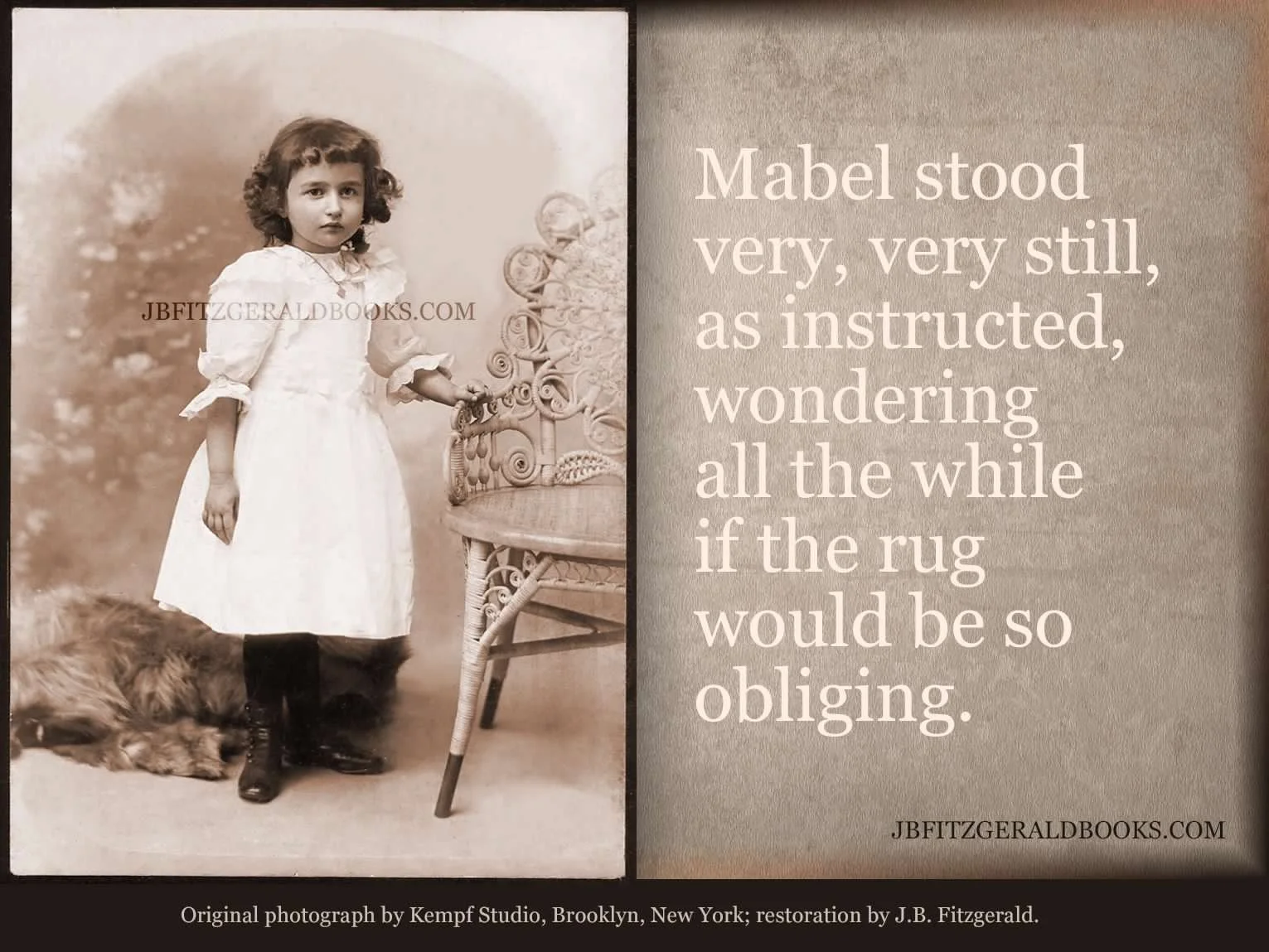
And, sometimes--Girl in Weird Coat forgive me--I will lend these restored likenesses to the expression of my peculiar sense of humor.

So, there you have it: one of my more eccentric pastimes. Much like when I’m nearing completion of a novel or an original painting, there is beauty and wonder in the process and a certain thrill in seeing it evolve. In the case of these old photographs, it is as close as a shutterbug can get to bringing history alive, to helping our ancestors emerge from the tattered grime of their dusty dormancies into an era of visual vitality. The work can be long. It can be tedious. But, inevitably, there's that rewarding moment of, "Oh, there you are..."
Hello, Franciszka. How wonderful to meet you. No, really, the pleasure is all mine.